Washington, D.C. license plates, permits, and vehicle registration history
![]() |
||
![]() |
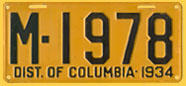
Motorist-provided markers were used until September 1907, when the city began to issue uniform porcelain enamel plates. These undated white-on-black plates were issued and used, with relatively minor design variations, through the end of 1917. Dated, embossed steel plates were introduced for 1918 and were issued annually through early 1942. There is, however, no D.C. plate dated "1939" due to the annual registration expiration date being switched from Dec. 31 to the end of February. At that time, data shown on the plate to indicate its period of use was changed from the calendar year of validity ("1938" was the last) to the expiration date ("EX-2-29-40" was the first). Further information about this subject appears below. |
![]() |
|
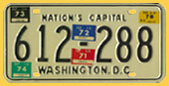
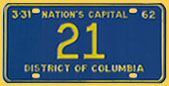
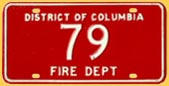
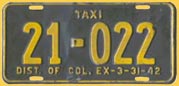
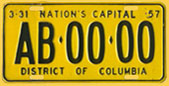
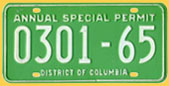
Special plates for vehicles other than privately-owned passenger cars, such as motorcycles, trucks, taxis, and government-owned vehicles, were introduced at various times from 1918 through about the 1970s. Plates introduced more recently are more apt to indicate something special about the vehicle owner, and to be offered at a premium price, rather than about the vehicle itself or its intended use(s). Washington, D.C. followed the practice of most of the states in using plates for multiple years during the World War II era in order to minimize non-military uses of metal. Plates first issued in April 1942 were used for three years, and new plates issued in April 1946 and April 1953 were both used for two-year periods. All of these multi-year plates were validated with metal tabs for their second (and third, if applicable) years of use. After the two-year 1953 (“3-31-54”) plate, the first in D.C. to include a slogan, was replaced in early 1955, another 11 annual issues were used before the switch to multi-year plates, validated with stickers, was made for good. It was during this period, in early 1962, that the District's first fully reflective plate was issued. In April 1966 the first of seven successive multi-year plates, which have brought us through to the present day, was introduced. Here is one example of the many characteristics of D.C. plates that confuse observers today: the manner in which the period of use was marked on them from the late 1930s through (at least) the mid-1970s. Shown and explained are three sets of passenger plates issued for two consecutive registration periods. |
![]() |
||
1938 (top) and 1939 plates |
1947 (top) and 1948 plates |
1952 (top) and 1953 plates |
1938 and 1939. The era of D.C. plates that is easiest to understand today is the 21-year period from 1918 through 1938, when plates were used for 12-month periods that corresponded to the calendar year marked on them. A decision had apparently been made by early-to-mid 1938 (by which time production of plates for the following year would have had to have commenced) to change the registration year from the calendar year to a twelve-month period beginning March 1 and ending on the final day of February. In order to accomplish the transition, the plate that would have been marked "1939" under the old system is instead marked "EX-2-29-40," the decision having been made to display the date of expiration, not the year of issue, on plates issued for the new period. To further confuse matters, the March-February registration year was used for only one year. Thereafter (until 1984), an April 1-March 31 period was used. Therefore:
1947 and 1948. For most of the 40+ years that the registration year remained unchanged (April 1 through March 31) a plate's period of validity was indicated with the expiration date. However, for a five-year period the year of issuance, not date of expiration, was shown. In order to accomplish the transition, upon the March 31, 1948, expiration of a plate marked (with a validation tab) "EX-3-31-48," a plate dated "1948" was issued and used until March 31, 1949. Four additional plates dated in this manner were used, the last being marked "1952" and used until March 31, 1953. 1952 and 1953. At the end of the five year-period described immediately above during which plates were embossed with the year of issuance, the manner of marking plates reverted to the expiration date method. To accomplish this change, expiration of the dated "1952" plate on March 31, 1953, was followed by the issuance of plates marked "3-31-54." |
|
|
|
|
DCplates.net welcomes contributions from license plate collectors and everyone else with an interest in plates issued during the past 105 years, including those on the roads today, in the Nation's Capital! Please refer to our About DCplates.net page for details on how to contribute. |
|
This page last updated on March 29, 2008 |
|
copyright 2008 Eastern Seaboard Press Information and images on this Web site may not be copied or reproduced in any manner without consent of the owner. For information, send an e-mail to admin@DCplates.net |