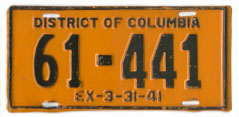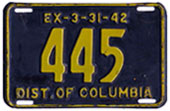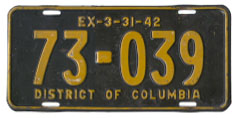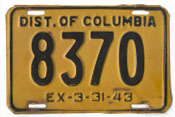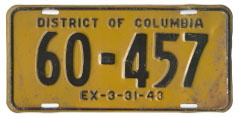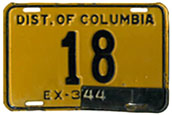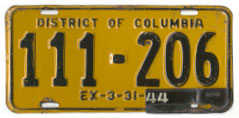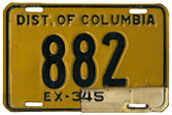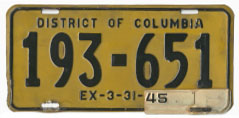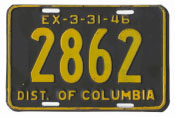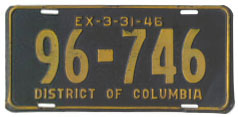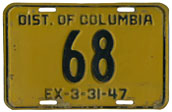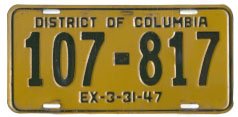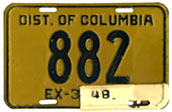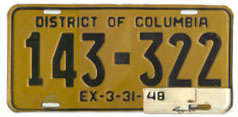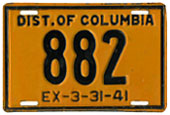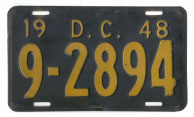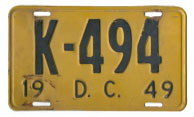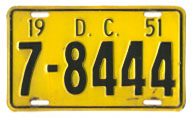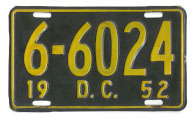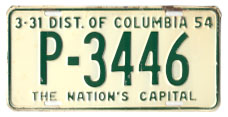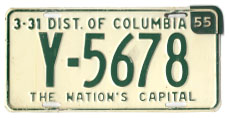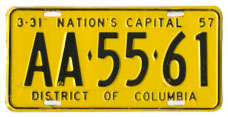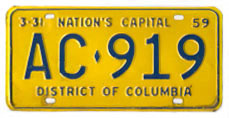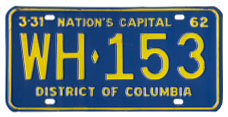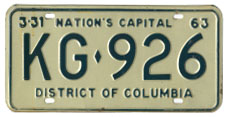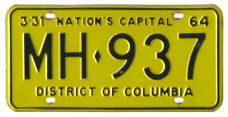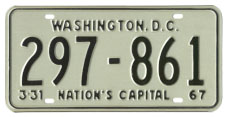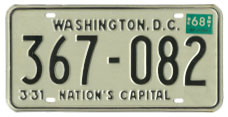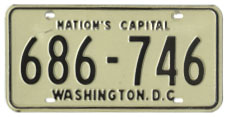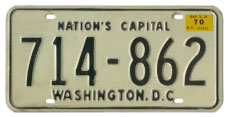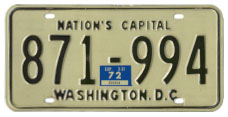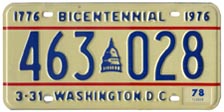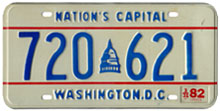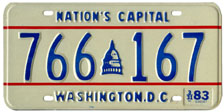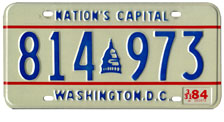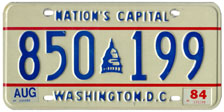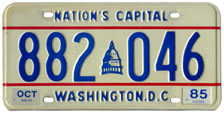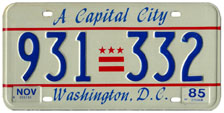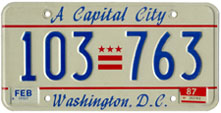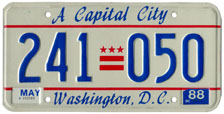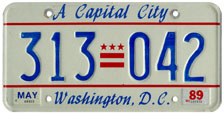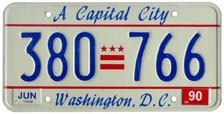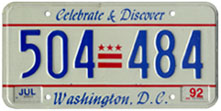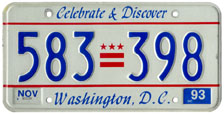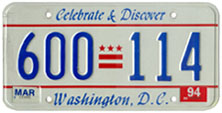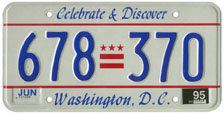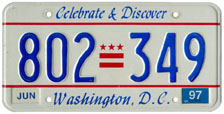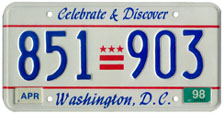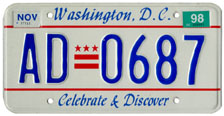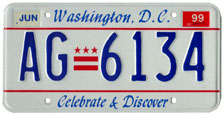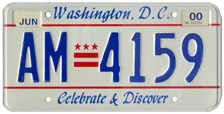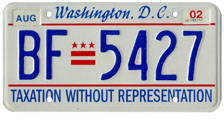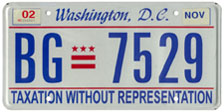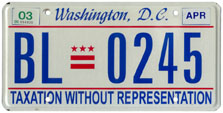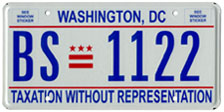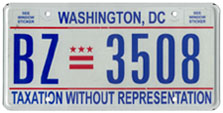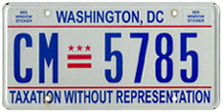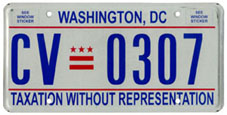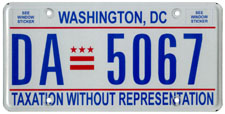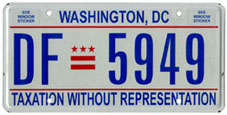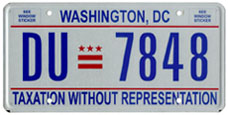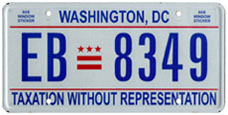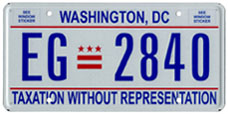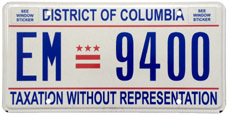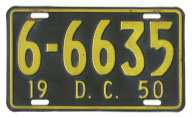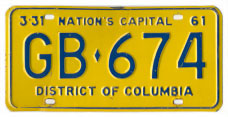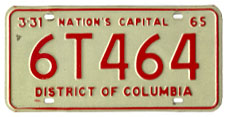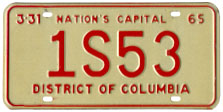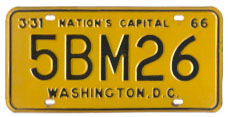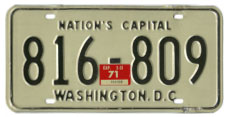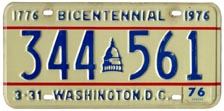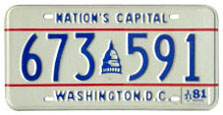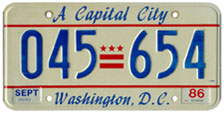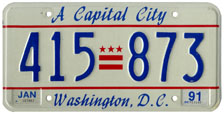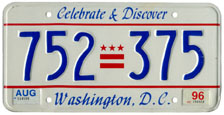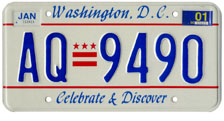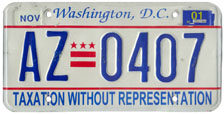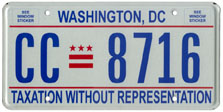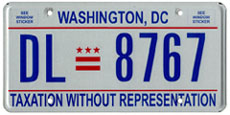












We hope that you enjoy viewing the photos that appear on this page. However, supplement your early D.C. plate experience by reading the stories behind them:
Registration Begins in D.C. |
Format Changes |
||
The Porcelain Era |
Highlights of 1935-1965 Plates |
||
Annual Plates Introduced |
Multi-Year Baseplates |
1907-1917 |
1918 |
|
![]() |
1919 |
![]() |
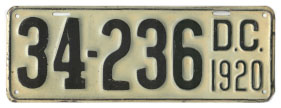
1920 Black on white, issued in pairs 5.5" x 15", embossed steel |
![]() |
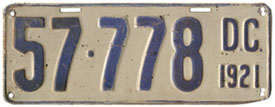
1921 Blue on white, issued in pairs 5.75" x 15", embossed steel |
![]() |
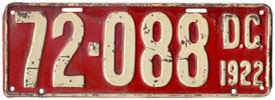
1922 White on red, issued in pairs 5.375" x 15", embossed steel |
![]() |
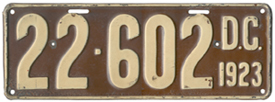
1923 White on brown, issued in pairs 5.375" x 15", embossed steel |
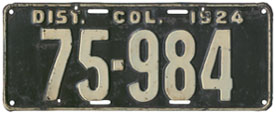
1924 |
|
![]() |
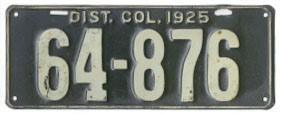
1925 White on dark gray, issued in pairs 6" x 15", embossed steel |
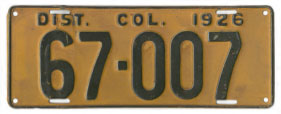
1926 Black on orange, issued in pairs 6" x 15", embossed steel |
|
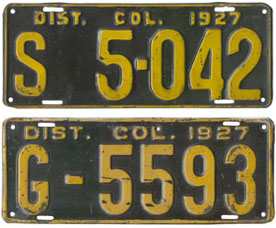
1927 As is evident in these 1927 plates there are two die varieties for this year, evidence that the total quantity of plates required was likely procured from (at least) two manufacturers. Follow this link to read about the introduction of letter prefixes to District of Columbia plates in 1927. |
|
![]() |
|
![]() |
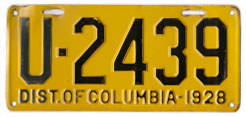
1928 Black on yellow-orange, issued in pairs 6" x 13", embossed steel |
![]() |
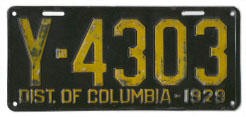
1929 Yellow on black, issued in pairs 6" x 13", embossed steel |
![]() |
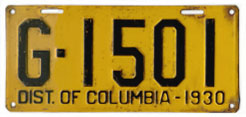
1930 Black on yellow-orange, issued in pairs 6" x 13", embossed steel |
![]() |
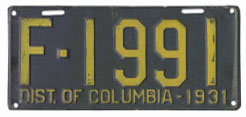
1931 Yellow on black, issued in pairs 6" x 13", embossed steel |
![]() |
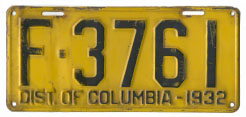
1932 Black on yellow-orange, issued in pairs 6" x 13", embossed steel |
![]() |
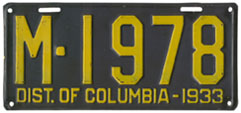
1933 Yellow on black, issued in pairs 6" x 13", embossed steel |
![]() |
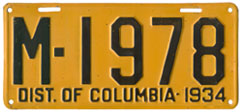
1934 Black on yellow-orange, issued in pairs 6" x 13", embossed steel |
![]() |
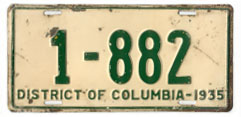
1935 Green on white, issued in pairs 6" x 12.5", embossed steel |
![]() |
![]() |
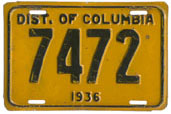
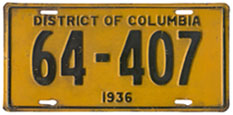
1936 Black on yellow, issued in pairs 6" x 9" (1-4 digits), 6" x 12.5" (5, 6 digits) embossed steel |
![]() |
![]() |
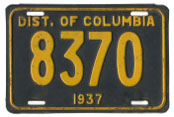
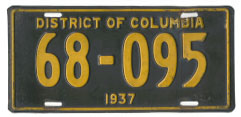
1937 Dark yellow on black, issued in pairs 6" x 9" (1-4 digits), 6" x 12.5" (5, 6 digits) embossed steel |
![]() |
![]() |
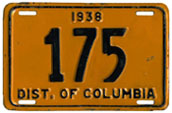
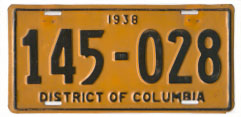
1938 Black on orange, issued in pairs 6" x 9" (1-4 digits), 6" x 12.5" (5, 6 digits) embossed steel |
![]() |
![]() |
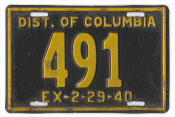
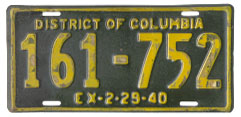
1939 Used Jan. 1, 1939, through Feb. 29, 1940. (Read more) Dark yellow on black, issued in pairs 6" x 9" (1-4 digits), 6" x 12.5" (5, 6 digits) embossed steel |
![]() |
![]() |
1940 Used Mar. 1, 1940, through Mar. 31, 1941. Follow this link to read more about 1940 plates. |
![]() |
![]() |
1941 Used April 1, 1941, through March 31, 1942. Follow this link to read more about 1941 plates. |
![]() |
![]() |
|
![]() |
![]() |
1943 1942 plate validated with a tab to expire 3-31-44. Follow this link to read more about 1943 plates. |
![]() |
![]() |
1944 1942 plate validated with a tab to expire 3-31-45. Follow this link to read more about 1944 plates. |
![]() |
![]() |
|
![]() |
![]() |
1946 Used April 1, 1946, through March 31, 1948. Follow this link to read more about 1946 plates. |
![]() |
![]() |
1947 1946 plate validated with a tab to expire 3-31-48. Follow this link to read more about 1947 plates. |
![]() |
1948 |
![]() |
1949 Used April 1, 1949, through March 31, 1950. Follow this link to read more about 1949 plates. |
![]() |
1950 Used April 1, 1950, through March 31, 1951. Follow this link to read more about 1950 plates. |
![]() |
1951 Used April 1, 1951, through March 31, 1952. Follow this link to read more about 1951 plates. |
![]() |
1952 |
![]() |
1953 First D.C. plate to include a slogan. Used April 1, 1953, through Mar. 31, 1954. Follow this link to read more about 1953 plates. |
![]() |
1954 |
![]() |
1955 Used April 1, 1955, through March 31, 1956. Follow this link to read more about 1955 plates. |
![]() |
1956 Used April 1, 1956, through March 31, 1957. Follow this link to read more about 1956 plates. |
![]() |
1957 Used April 1, 1957, through March 31, 1958. Follow this link to read more about 1957 plates. |
![]() |
1958 Used April 1, 1958, through March 31, 1959. Follow this link to read more about 1958 plates. |
![]() |
1959 Used April 1, 1959, through March 31, 1960. Follow this link to read more about 1959 plates. |
![]() |
1960 Used April 1, 1960, through March 31, 1961. Follow this link to read more about 1960 plates. |
![]() |
1961 Used April 1, 1961, through March 31, 1962. Follow this link to read more about 1961 plates. |
![]() |
1962 |
![]() |
1963 |
1964 Two general-issue numbering configurations, as pictured, were used due to the supply of available numbers in the first (1A234) having been exhausted before the end of the registration year. Follow this link to read more about 1964 plates. |
|
1965 First plate with WASHINGTON, D.C. Used April 1, 1965, through March 31, 1966. Follow this link to read more about 1965 plates. |
|
![]() |
|
![]() |
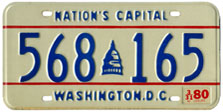
1967 1966 baseplate is validated with a sticker for the 1967 registration year, to expire 3-31-68. Click here to reach a page dedicated to this base. |
![]() |
|
![]() |
1969 |
![]() |
1970 1968 baseplate is validated with a sticker placed in the center (below the dash) for the 1970 registration year, to expire 3-31-71. Click here to reach a page dedicated to this base. |
![]() |
1971 1968 baseplate is validated with a sticker placed in the center (above the dash) for the 1971 registration year, to expire 3-31-72. Click here to reach a page dedicated to this base. |
![]() |
1972 1968 baseplate is validated with a sticker placed in the upper left corner for the 1972 registration year, to expire 3-31-73. Click here to reach a page dedicated to this base. |
![]() |
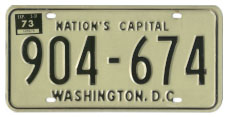
1973 1968 baseplate is validated with a sticker placed in the lower left corner for the 1973 registration year, to expire 3-31-74. Click here to reach a page dedicated to this base. |
A variety of factors contributed to the need felt by local and state governments at the dawn of the twentieth century to tax and regulate the use of motor vehicles and their operators. In September 1893 the nation's first practical (by standards of the day) self-propelled machine was operated on the streets of Springfield, Mass., by Charles E. and J. Frank Duryea. Four years later, no less than four companies were organized for the purpose of producing motorized vehicles. Although these early cars were crude, often little more than the chassis and body of a horse-drawn buggy with an engine installed, within a decade cars were large and fast enough that they began to take a serious toll on roads designed for slower, more gentle traffic powered by oats rather than gasoline, steam, and electricity. Revenue needed to be raised to fund road maintenance and construction, and the increasing number of vehicles needed to be tracked. Registration was the answer, and license plates soon followed.
In April of 1901, New York became the first state to require that vehicles be registered, but motorists were required to make or otherwise procure their own markers. In 1903, a registration law took effect in Massachusetts that included the provision, by the state, of what were the nation's first uniform, state-issued license plates. Rhode Island became the second state to require registration and provide uniform plates, in 1904, and other states, mostly in the Northeast, followed in the ensuing years.
As occurred in many states, the earliest license plates used in the District of Columbia were provided by vehicle owners and took many forms, often leather pads with metal house numbers attached. In many cases the assigned number was simply painted directly on the vehicle. The only requirements as to the manner in which registration numbers were shown is that figures had to be at least 3 in height with a stroke of not less than 3/8. Only the number was required to be displayed until Oct. 24, 1904, when an amendment to the city Automobile Board's regulations took effect requiring that DC also be included. Although there was no fee when registrations were first required in late August 1903, applicants had to appear before the Automobile Board in order that their competence could be ascertained.
The Automobile Board had been created in 1903 by the city's Board of Commissioners, members of which were appointed by the president to execute administrative matters of running the city's government. (In 1968 the Board of Commissioners was replaced by the current mayor and city council form of administration.) As is still the case today, in 1903 legal oversight of the District was vested in Congress. Under this system, both the House and Senate have committees that, through their power, facilitate day-to-day operations of city government.
Regulations adopted by operational-level panels, such as the Automobile Board, take effect after a mandatory Congressional review period. That period for the District's first vehicle registration regulations lapsed, apparently without Congressional comment, on August 29, 1903. The first registrations were then assigned based upon regulations that had been adopted by the Board of Commissioners on May 3, 1903.
Annual reports of the Automobile Board indicate that 2,463 vehicle registrations were issued during the period during which motorists were required to provide their own way of displaying their assigned number. This period covered four years, one month, and one day: from Aug. 29, 1903, through Sept. 30, 1907. During this period, no distinction, for purposes of registration, is known to have been made between vehicles of various types.
Whether the first number issued was 1 or 100 is unknown, but plate numbers up to approximately 600 are believed to have been assigned during the final 125 days of 1903. Numbers issued from the beginning of 1904 through the end of Sept. 1907 are as follows: 1904, c.600-994; 1905, 995-1510; 1906, 1511-2037, and 1907, 2038-2463.
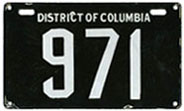
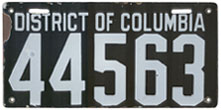
The curtain closed on the District's homemade plate era at the end of September 1907. Replacing the variety of owner-provided markers and numbers displayed in other fashions were uniform, white-on-black undated porcelain plates, issued singly, that were provided by the D.C. government and used for ten years. They were first issued on Oct. 8, 1907, and all holders of existing registrations received one during October. There are two distinct varieties of this plate, with more subtle differences existing in both styles. For purposes of this discussion, we refer to the earlier style as type 1 and the later as type 2.
Type 1 plates are characterized by 1/2 lettering used for DISTRICT OF COLUMBIA, which appears across the top of all 1907-1917 plates, whereas this feature on type 2 plates is displayed in much bolder 1 letters. (See example above.) The change in lettering style appeared on plates issued during mid-1914 at some as yet unidentified point between plates 19840 (small lettering) and 19968 (large lettering). All 1907-17 plates are 6 high, and all type 1 plates, as well as type 2 plates numbered up to 9999 are 10 wide. When a fifth digit was added in 1912 the width was increased to 12, resulting in a plate identical in its dimensions to modern North American plates.
As for registration numbers, type 1 plates, manufactured by the Lamb & Tilden Co., of Washington, are numbered from 100 through 2500. Although not all later plates are marked as to their origin, at least some bear the maker's seals of prominent porcelain plate manufacturers Baltimore Enamel & Novelty Co., of Baltimore, Md., and Ingram-Richardson Co., of Beaver Falls, Pa. It is reported in the work cited in the following paragraph that Baltimore Enamel and Novelty likely made the majority of the post-Lamb and Tilden plates. Only a relatively small number, less than 2,000, can be directly associated with Ingram-Richardson.
Exactly which registration numbers were issued annually during this period is unknown, but a set of seemingly reliable estimates has been made. Much of our pre-1918 plate information comes from Nine Decades of Automobile Licensing in the Nation's Capital by early registration and plate historian Stephen J. Raiche, a former D.C. resident. In his 1994 work, the author writes that although early records are incomplete, it is possible, however, to project a year-by-year breakdown of the numbers issued on the porcelain plates by carefully analyzing monthly registration totals and revenue collections reported in detail by the Automobile Board. The figures presented in the table below are presumed to be quite reliable since the highest tag known in a collection correlates within 1,000 numbers of the projected figure for the last issued plate. The totals below assume the lowest number to have been #100, and presume that all duplicate tags (i.e. replacements for lost or mutilated originals) would have received new numbers.
1907 |
100-1541 |
1908 |
1542-2548 |
1909 |
2549-4343 |
1910 |
4344-6272 |
1911 |
6273-9289 |
1912 |
9290-12868 |
1913 |
12869-16862 |
1914 |
16863-24803 |
1915 |
24804-33668 |
1916 |
33669-45525 |
1917 |
45526-61395 |
Note that registration numbers listed above do not correlate to the number of vehicles in use at any single point in time. Vehicles were routinely removed from service or taken out of the District, resulting in assigned numbers no longer being used. The city's superintendent of licenses, who took over responsibility for the registration of vehicles during 1917, estimated at the end of that year (as 1907-17 plates were at the end of their useful lives) that approximately 25,000 vehicles were likely in use in the District at the time.
With the introduction of city-issue plates in late 1907, a $1 one-time registration fee was charged, presumably to cover the cost of the plate. These plates could legally be displayed only on the vehicle to which they were first assigned; that is, they could not be transferred to another vehicle or individual.
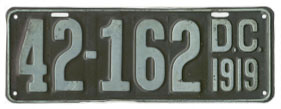
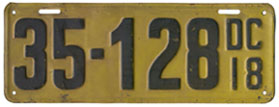
Washington, D.C. joined most of the states in 1918 when it switched to a system under which new, dated plates were issued to all vehicle owners annually. The (originally) bright yellow 1918 plates were issued singly, but all subsequent D.C. auto plates, with one exception during World War II, have been issued in pairs. Furthermore, all plates from 1918 through the 1966 (dated 3-31 67) plate are embossed steel, whereas later plates are aluminum. Due to poor paint quality and having been made singly, 1918 plates are among the most difficult for collectors to locate in good original condition today.
The layout of D.C. plates was changed in 1924. Jurisdiction and year designations were moved to the top to more comfortably accommodate a sixth digit in the registration number, which is known to have been required in 1923. DCplates.net assumes that 1923 was the first year for which numbers above 99-999 were required, for if their use was required earlier presumably the change in plate format would have occurred earlier, as well.
The next noteworthy changed occured for 1927 with the addition of a prefix letter to most plates in order to avoid the continued need for six-number auto plates and to distinguish among various types of non-passenger plates. Private auto plates of 1927 through 1934 are numbered 1 through 9999 and with certain letters followed by numbers 1 through 9999 (e.g. E-1 through E-9999).
Records indicate that letters used on passenger plates during this era (although not all of these letters were used in every year from 1927 through 1934) are: E, F, G, J, K, M, N, O, P, Q, T, U, V, W, Y, and Z. However, that O and Q were actually ever used appears doubtful based upon the lack of surviving examples. The exclusion of these letters until the supply of numbers prefixed by all other listed letters had been exhausted appears reasonable based upon their similar appearance to each other and the number zero. Letters I and J are known to have not been used on plates of this era due to their similarity.
Beginning in 1927, plates that begin with certain letters were issued exclusively for use on non-passenger vehicles, as follows: A, U.S. and District government; B, commercial vehicles 2,500 lbs. or less; C, commercial vehicles heavier than 2,500 lbs; D, dealer; H, taxis and other public for hire vehicles; L, livery vehicles; R, rental cars; and X, non-resident.
1935: For 1935 a return to all-number passenger registrations was made. The system of letter prefixes was abandoned, at least temporarily, and plates with numbers as high as needed (slightly above 200-000 in at least one year) were issued until early 1948. It was also in 1935 that the lowest all-number plates were considered reserved, as discussed on the Reserved Pass. page.
1936: D.C. plates were made in two sizes from 1936 through 1946 (dated EX-3-31-47). Plates with four or fewer characters were made on the smaller plate (6x9), which has the city's name abbreviated to DIST. OF COLUMBIA. Larger plates are 6x12.5.
1939: From 1918 through 1938, the period during which vehicle registrations were valid (the registration year) coincided with the calendar year. A change was made in D.C. (and several other U.S. jurisdictions) in the late 1930s, however, and to transition to a new registration year, 1939 D.C. plates are marked EX-2-29-40 and were used for 14 months. Thus, there is no D.C. plate marked 1939.
1955-1965: Notable changes to annual D.C auto plates issued during these years are mostly seen in non-reserved numbering formats used. (See the Reserved Pass. page for information on numbers set aside for special assignment.) The 1955 and 1956 plates (marked 3-31-56 and 3-31-57, respectively) are numbered in a somewhat unusual format that had been adopted two years earlier by Maryland: AB-12-34. Certain two-letter series of these and later plates were reserved for non-passenger use.
On the 1957 (3-31-58) through 1963 (3-31-64) plates the general-issue numbering format is two letters followed by three numbers. By far the most noteworthy change during this period was the introduction of reflectorization in 1962. The green-on-white 3-31-63 plates were the first issued in D.C. to be covered with reflective sheeting instead of paint, and all plates issued since in the Nation's Capital have been reflective.
The District's last two annual issues each used distinctive general-issue numbering formats. Letters I, O, and Q were not used on either the 1964 (3-31-65) or 1965 (3-31-66) plates, but all other letters were used on passenger car plates in contrast to the 1927-34 and 1948-63 systems under which certain letters were set aside for use only on non-passenger plates.
The 1964 (3-31-65) configuration is 1A234, with numbers issued from 1A101 through 9Z998. (Triple-repeating numbers were not used following the letter. For example, plates such as 1A111, 1A222, and 1A333 were not issued.) This configuration apparently didn't provide quite enough registration number combinations (when combined with the reserved number plates also being assigned), because at least a few auto plates numbered with a 1A23 format are also known. It is unknown how many plates of this unusual configuration were needed and issued, but that even a few were required likely caused the configuration to be changed again for 1965.
The final annual general-issue plate issued in Washington, D.C., the 1965, is numbered with a 1AB23 format. The series of 1AA01 through 9MZ98 provided more than enough combinations to register all passenger cars owned by D.C. residents in the mid-1960s. As with the 1964 plate, no plates with triple-repeating numbers such as 1AA11, 2AA22, and 3AA33 were issued.
It is the six multi-year baseplates issued since the mid-1960s that were the impetus for this Web site. As such, they are treated separately from this page. General-issue plates are summarized on one page, from which pages with details about each of the baseplates can be reached. Information about other styles of plates (low-number, optional, and non-passenger) issued since 1966 may be found on other pages.
|
This page last updated on July 16, 2008 |
|
copyright 2008 Eastern Seaboard Press Information and images on this Web site may not be copied or reproduced in any manner without consent of the owner. For information, send an e-mail to admin@DCplates.com |